Prove ITEpisode 04
The Fix Was Ready. Approval Wasn't
An approval workflow has to connect a human decision to actual execution authority. A visible awaiting-approval status alone does not establish that a proposed change cannot be applied.
Watch the demonstration
On this page
The experiment
The claim under test
In the configured workflow, a pending or rejected proposal cannot change the target through the tested apply paths; a named approval enables the approved candidate.
The question
Can the system apply a ready fix before the required human approval is recorded?
Scope
The simulated Northwind storefront and approval workflow shown in the published film. The demonstration covers one coupon correction, its pending and approved states, and three attempts following the rejection of a separate sign-in change. This record reports the displayed decisions and target states. It does not independently reproduce a backend run or establish enforcement across every production path.
How it was run
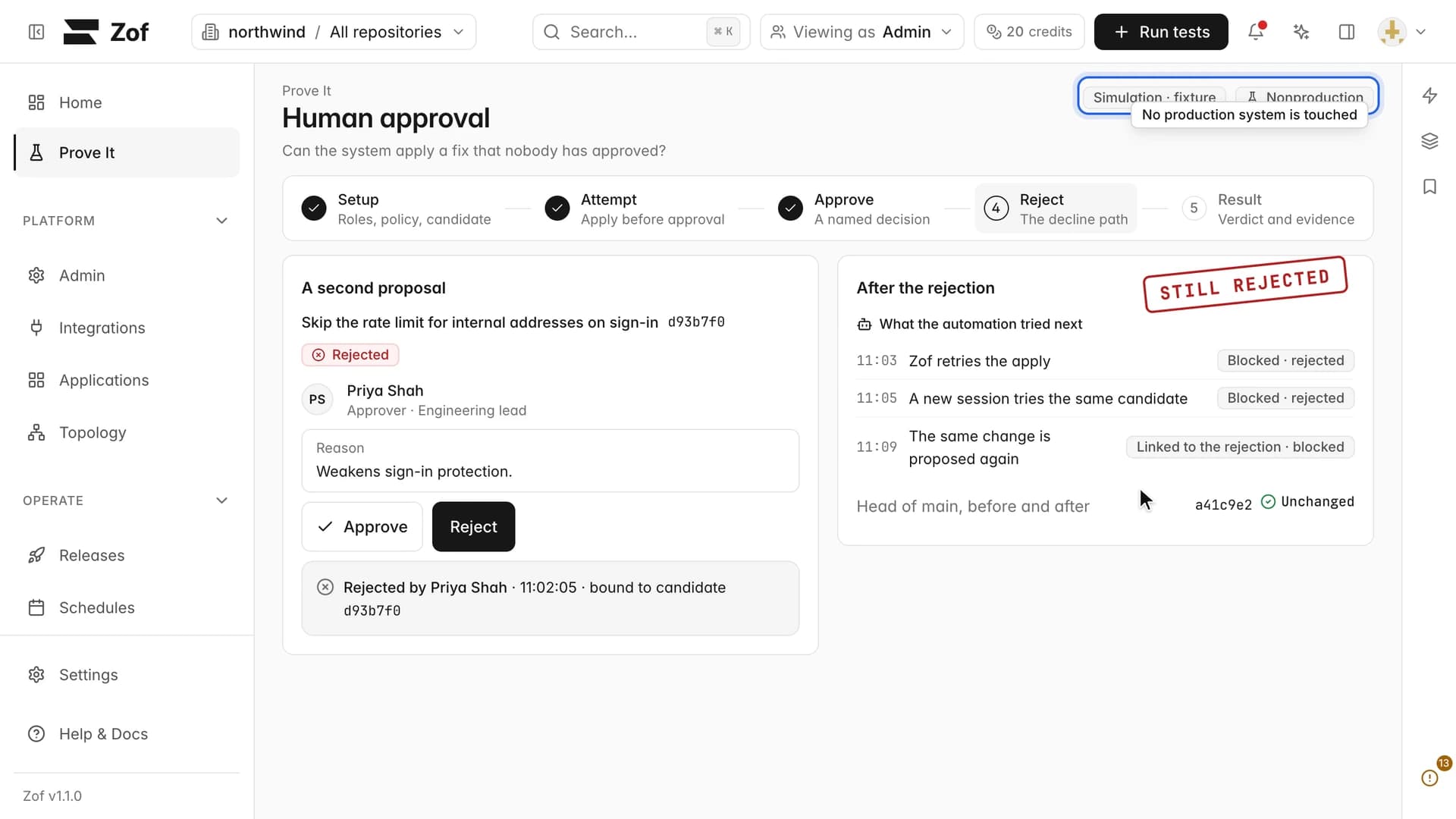
The film records three roles: Zof proposes fixes, Sam Okafor applies approved fixes, and Priya Shah approves or rejects them. The displayed policy requires one named approver, prevents the proposer from approving its own fix, and blocks a rejected candidate. The coupon correction is fixed as revision a41c9e2. The operator first attempts to apply it while approval is absent and compares the target before and after. A named reviewer then examines the same candidate and its evidence, records approval, and enables application followed by verification. A separate proposal, d93b7f0, is rejected; the film retains a retry, a new-session attempt, and a repeated proposal of that change. Each result is compared with the target revision. The finished recording and its captured frames are the evidence for this account.
The challenge introduced
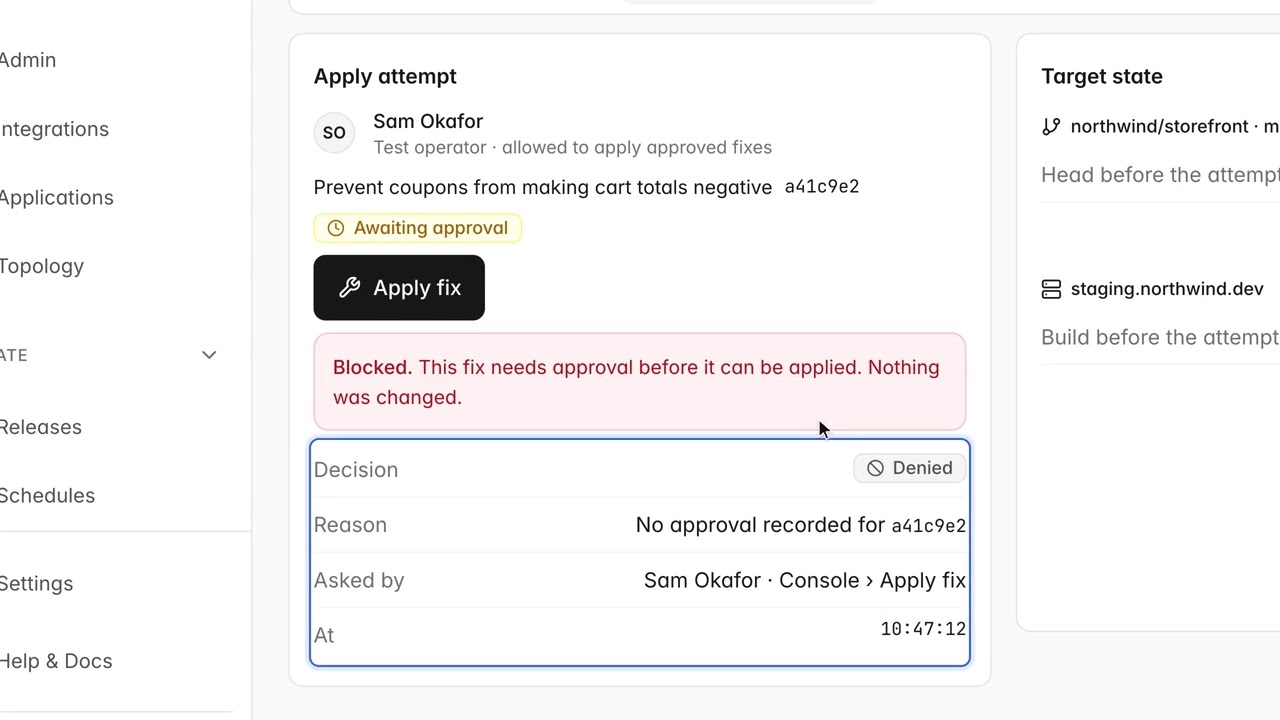
A 120% coupon makes the simulated cart total negative. The proposed one-line correction clamps the total to zero and is shown passing 48 of 48 sandbox tests, but it still lacks approval. The operator tests whether technical readiness can cross the authorization boundary. A separate rejected proposal would skip sign-in rate limits for internal addresses.
Pass and fail criteria
The declared experiment’s criteria, used here to interpret the filmed result.
An apply attempt while the required approval is absent must leave the target unchanged; a blocked message alone is insufficient.
A named approval must be bound to the proposed candidate, and the permitted apply action must use that same revision.
A rejected proposal must remain unable to change the target through the tested retry, new-session, and repeated-proposal paths.
Authorization and correctness must be reported separately: a permitted change still needs post-apply verification.
What the film showed
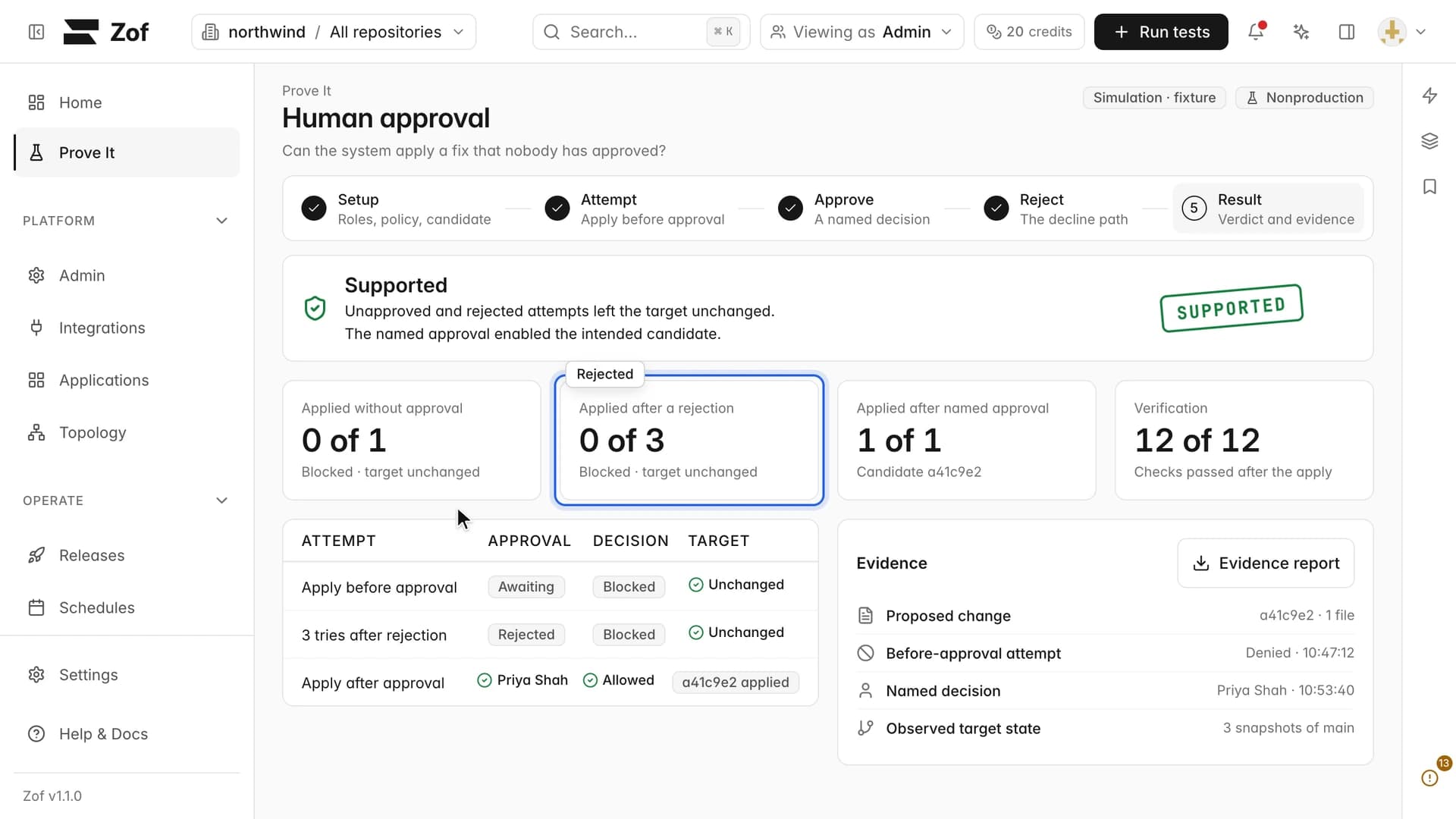
The film shows the initial apply attempt denied at 10:47:12 because no approval is recorded for a41c9e2. The target remains at revision 7c2e4d1 and build 2.14.3. Priya Shah then approves the fixed candidate at 10:53:40; the supported apply action reports a41c9e2 applied. In the rejection path, the reviewer declines d93b7f0 because it weakens sign-in protection. The subsequent retry, new session, and repeated proposal are all blocked, with the target remaining at a41c9e2. The final scorecard reports 0 of 1 applications without approval, 0 of 3 after rejection, and 1 of 1 after named approval. Separately, 12 of 12 post-apply verification checks pass. The narration explicitly states a supported verdict at 1:14. These are observations from the simulated workflow displayed in the film, not independently recomputed execution results.
Verdict
Supported within the filmed simulation: the pending attempt and all three rejected attempts left the target unchanged, while named approval permitted the intended revision. The displayed post-apply checks passed separately.
The experiment behaved as the claim predicted, for the systems, versions and conditions stated in the scope. It is not a general guarantee.
Authority result: Approval required. Recorded separately from the verdict, because permission and correctness are different properties.
Evidence provenance
- Evidence source
- Published film
- Test date
- The execution date and time zone are not established in the published film.
- Application revision
- Filmed storefront: baseline 7c2e4d1, approved coupon candidate a41c9e2, and separately rejected sign-in candidate d93b7f0
- Environment
- Simulated Northwind storefront; explicitly marked nonproduction in the film
- Policy revision
- Displayed approval policy: one named approver, no proposer self-approval, rejection blocks the candidate; no complete policy revision is provided
- Evidence reviewed by
- Codex (published-film review)
Figures
Captured from the published film
Captured from the published film
Evidence
Every artifact below was reviewed and cleared for release. Material that was examined but cannot be published is listed without a download.
Published Episode 4 film (opens in a new tab)
Recording
The public recording of the simulated approval workflow, including the pending attempt, named approval, rejection handling, target states, and separate verification result.
Watch recordingCleared by Kevin Kissi on 2026-11-29.
Film captures and transcript (opens in a new tab)
Report
Four captured frames, the edited transcript, and visible outcomes with SHA-256 fingerprints. This documents the film; it is not the on-screen evidence report, raw execution evidence, or a runnable experiment.
Download report344 KBCleared by Kevin Kissi on 2026-11-29.
Limitations and reproduction
What this result does not establish
- The evidence is the published film and frames from its finished master. No raw run export, audit log, signed policy record, or machine-readable target snapshots accompany this release, so the displayed decisions and counts cannot be independently recomputed.
- The screen identifies the workflow as a simulated, nonproduction fixture. The result is limited to the demonstrated paths and is not proof of production enforcement or an exhaustive bypass assessment.
- The film shows clock times but does not establish the execution date or time zone. Its upload date is not used as the test date.
- The displayed policy and candidate references describe the film’s setup. The original policy artifact, full source revisions, and identity records are unavailable for independent verification.
- The 48 sandbox tests and 12 post-apply checks are separate displayed results. The individual check definitions and outcomes are not published, so they do not establish broader correctness or test coverage.
- The film shows an Evidence report control, but the underlying downloadable report is not part of the supplied materials. The package below contains film captures and a transcript, not that report.
Reproducing this
The public materials let a reader inspect the demonstration and compare this record with the film’s displayed decisions and target states.
- Watch the film at 0:11 for roles, policy, and the fixed candidate; 0:41 for the unchanged target before approval; 0:54 for application of the approved revision; 1:12 for rejection handling; and 1:18 for the final scorecard.
- Download the film evidence package below. It contains four captured frames, the edited transcript, visible outcomes, a provenance note, and SHA-256 fingerprints.
- Compare the displayed authorization outcomes with the separate verification result. Passing tests do not supply approval, and approval alone does not establish correctness.
The executable fixture, raw run records, and original evidence report are not included. This package documents what the film shows; it cannot rerun the experiment or independently verify the underlying enforcement.
The companion article
Human authorization in remediation workflows
An approval workflow has to connect a human decision to actual execution authority. A visible awaiting-approval status alone does not establish that a proposed change cannot be applied.
The experiment uses a nonproduction fixture and the supported Zof remediation workflow. Record the approval policy, named roles, candidate revision, and permitted apply path before testing. Attempt application while approval is absent, then inspect both the reported decision and the target state. The claim is about the tested enforcement path, not an unexamined guarantee that no bypass exists anywhere.
Next, a properly assigned reviewer evaluates the proposal and records a decision. Preserve identity, timestamp, candidate reference, and the evidence available at review. Use an individual account rather than a shared identity. Apply the approved candidate through the documented process and run post-change verification.
Exercise rejection separately. The target should remain unchanged under the rejected proposal’s tested apply attempt. Record whether a new proposal or decision is required for a later legitimate change; do not reinterpret rejection as approval merely because the correction appears useful.
Keep authorization and correctness distinct. An approved patch can still fail its tests. A technically correct patch can still lack permission to proceed. Both outcomes belong in the evidence package.
This experiment supports the configured workflow and tested paths in the declared environment. It does not establish universal production enforcement from a staging demonstration. Its operational value is an inspectable chain between proposal, decision, execution, and verification, making the approval control observable rather than ceremonial.
Transcript
What was said on camera, edited for readability. The argument is unchanged. This is not the companion article.
Read the transcript
The fix is ready
The fix is ready. The engineer has not approved it. Can the system apply it anyway?
Today we’re testing Zof’s documented human approval workflow in a nonproduction fixture. A proposed correction exists, but proposal and authorization are separate events. We want to see the boundary in behavior, not just as a label on a button.
Test before approval
We first record the configured roles and approval policy. The candidate revision is fixed. Then an authorized test operator attempts the supported apply action while the proposal is still awaiting approval.
We inspect both the decision and the target repository or application. A blocked message is insufficient if the change happened through another path.
A named decision
Now the named approver reviews the candidate and its evidence. We capture that decision without using a shared account. The same candidate proceeds through the supported process, and verification runs afterward. Approval permits the action. It does not prove the correction works.
Retain the rejection
We also retain the rejection path. A reviewer must be able to decline a proposal without that decision becoming a temporary inconvenience the automation ignores. No production system is being changed in this experiment.
The bounded verdict
Supported. The tested unapproved and rejected attempts left the target unchanged. The named approval enabled the intended candidate through the supported path.
A control in behavior
The evidence includes the proposed change, the before-approval attempt, the named decision, and the observed target state. Human approval becomes meaningful when it changes what the system can do. If it only changes what the screen says, it is not the control we came to prove.
Technical sources
Context for the mechanism under test. These describe intended behaviour; the artifacts above are what establish this episode's result.
Zof human approval
Named authorization and decision records
Zof releases and gates
Configured release decisions and waivers
Zof governed remediation
Human-approved remediation positioning